
Why education in Shahada mattered
In 1969, Annasaheb P. K. Patil founded the Mandal to serve education in a remote, largely tribal and agricultural region of Maharashtra. This is the story of that decision — and of the ideas and the community behind it.
The place
Shahada lies in Nandurbar district, about 450 km from Mumbai, close to the borders of Gujarat and Madhya Pradesh. It sits between the Tapti river and the Satpura ranges, a stretch known as the Tapti Valley. Farming shapes life here: cotton, soyabean, pulses, maize, bananas and sugarcane are among the crops grown.
Much of the population is tribal or from farming families with little land. The Mandal says that, for years, many of these families had not had a single member formally educated — and that most of the students who come to its colleges are from tribal and farming families.
The decision, 1969
On 29 December 1969, under the leadership of its founder-president, Annasaheb P. K. Patil, the Mandal was established as a public trust — in the Mandal's words, “to serve the sacred cause of education in remote, tribal area” of Maharashtra. Its first college, for Arts, Science and Commerce, opened in 1970.
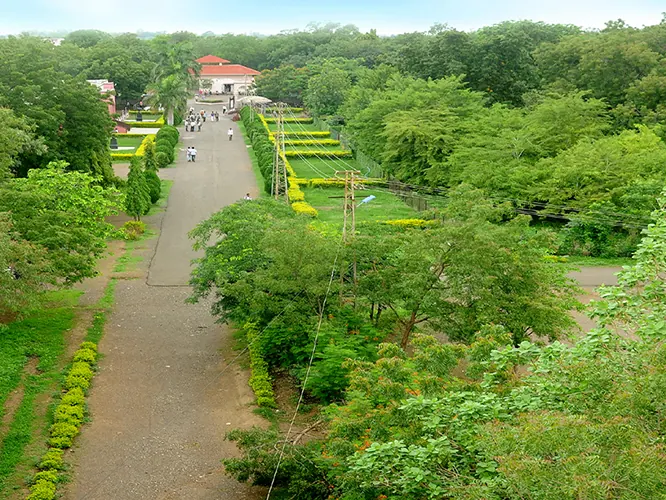
The colleges came up on a 200-acre campus on the banks of the Gomai and Susari rivers. Today the Mandal's institutions span arts, science and commerce; engineering and polytechnic education; pharmacy; agriculture; teacher education; management; and language and vocational study centres.

Milestones
Key dates in the history of the Mandal and its colleges.
-
9 October 1923
Annasaheb P. K. Patil, the Mandal's founder, is born at Lonkheda, near Shahada.
-
1942
As a young man he takes part in the Quit India movement at Nandurbar.
-
29 December 1969
Poojya Sane Guruji Vidya Prasarak Mandal is established and registered as a public trust.
-
1970
The Arts, Science and Commerce College opens at Shahada — the Mandal's first college.
-
1983
D. N. Patel College of Engineering is established, extending the Mandal into professional and technical degree education.
-
1986
The College of Education is established, bringing teacher education to the region.
-
1994
Pharmaceutical education begins at Shahada.
-
2020–21
The Arts, Science and Commerce College observes its Golden Jubilee, fifty years after it opened.
Two influences
The Mandal's name and its founding both point to two people.
Sane Guruji
The teacher, writer and freedom fighter (1899–1950) whose name the Mandal carries, and whose thought guided its founder.
Annasaheb P. K. Patil
Freedom-movement participant, cooperator and educator (1923–2014), who founded the Mandal and is remembered as Sahakar Maharshi and Shikshan Maharshi.
What the Mandal stands for
The Mandal describes its commitments this way:
- Equality of opportunity. In the spirit of justice and equality of opportunity in the Constitution, it encourages higher education among weaker and socially disadvantaged sections of society.
- Choice and diversity. Flexible curricula that let young people experience choice and diversity.
- A safe place to learn. An environment in which everyone feels safe and secure.
- The whole student. Spiritual, moral, intellectual, physical, social and emotional development, especially of students who come from tribal areas.
A community's gift
The Mandal's history records that farming families across the region have long contributed to its work — at weddings, religious ceremonies and other occasions — out of trust in its founder and in the cause. It describes this tradition as continuing after the founder's passing.
The Mandal today
Six colleges — alongside other institutes and study centres — now carry the Mandal's work into the classroom, each college with its own website, admissions and notices. This site is the Mandal's home: its story, its leadership and the way in to each college.